A transparent discovery signal based on current public GitHub metadata.
Recent activity35% weight
100
Community adoption25% weight
68
Maintenance state20% weight
100
License clarity10% weight
100
Project information10% weight
75
This score does not audit code, security, maintainers, documentation quality, or suitability. Verify the repository and its current documentation before adoption.
README preview
DEPRECATED 🚨
This Docker image is now deprecated. There's no need to use it, you can just use Uvicorn with --workers. ✨
🚨 These tags are no longer supported or maintained, they are removed from the GitHub repository, but the last versions pushed might still be available in Docker Hub if anyone has been pulling them:
python3.9
python3.9-slim
python3.8
python3.8-slim
python3.7
python3.9-alpine3.14
python3.8-alpine3.10
python3.7-alpine3.8
python3.6
python3.6-alpine3.8
The last date tags for these versions are:
python3.9-2025-11-09
python3.9-slim-2025-11-09
python3.8-2024-11-02
python3.8-slim-2024-11-02
python3.7-2024-11-02
python3.9-alpine3.14-2024-03-11
python3.8-alpine3.10-2024-01-29
python3.7-alpine3.8-2024-03-11
python3.6-2022-11-25
python3.6-alpine3.8-2022-11-25
Note: There are tags for each build date. If you need to "pin" the Docker image version you use, you can select one of those tags. E.g. tiangolo/uvicorn-gunicorn-fastapi:python3.11-2024-11-02.
The achievable performance is on par with (and in many cases superior to) Go and Node.js frameworks.
This image has an auto-tuning mechanism included to start a number of worker processes based on the available CPU cores. That way you can just add your code and get high performance automatically, which is useful in simple deployments.
🚨 WARNING: You Probably Don't Need this Docker Image
You are probably using Kubernetes or similar tools. In that case, you probably don't need this image (or any other similar base image). You are probably better off building a Docker image from scratch as explained in the docs for FastAPI in Containers - Docker: Build a Docker Image for FastAPI.
Cluster Replication
If you have a cluster of machines with Kubernetes, Docker Swarm Mode, Nomad, or other similar complex system to manage distributed containers on multiple machines, then you will probably want to handle replication at the cluster level instead of using a process manager (like Gunicorn with Uvicorn workers) in each container, which is what this Docker image does.
In those cases (e.g. using Kubernetes) you would probably want to build a Docker image from scratch, installing your dependencies, and running a single Uvicorn process instead of this image.
If you definitely want to have multiple workers on a single container, Uvicorn now supports handling subprocesses, including restarting dead ones. So there's no need for Gunicorn to manage multiple workers in a single container.
You could modify the example Dockerfile from above, adding the --workers option to Uvicorn, like:
If you are creating a new Starlette web application and you want to discard all the additional features from FastAPI you should use tiangolo/uvicorn-gunicorn-starlette instead.
Note: FastAPI is based on Starlette and adds several features on top of it. Useful for APIs and other cases: data validation, data conversion, documentation with OpenAPI, dependency injection, security/authentication and others.
How to use
You don't need to clone the GitHub repo.
You can use this image as a base image for other images.
Assuming you have a file requirements.txt, you could have a Dockerfile like this:
FROM tiangolo/uvicorn-gunicorn-fastapi:python3.11

COPY ./requirements.txt /app/requirements.txt

RUN pip install --no-cache-dir --upgrade -r /app/requirements.txt

COPY ./app /app
It will expect a file at /app/app/main.py.
Or otherwise a file at /app/main.py.
And will expect it to contain a variable app with your FastAPI application.
Then you can build your image from the directory that has your Dockerfile, e.g:
docker build -t myimage ./
Quick Start
Build your Image
Go to your project directory.
Create a Dockerfile with:
FROM tiangolo/uvicorn-gunicorn-fastapi:python3.11

COPY ./requirements.txt /app/requirements.txt

RUN pip install --no-cache-dir --upgrade -r /app/requirements.txt

COPY ./app /app
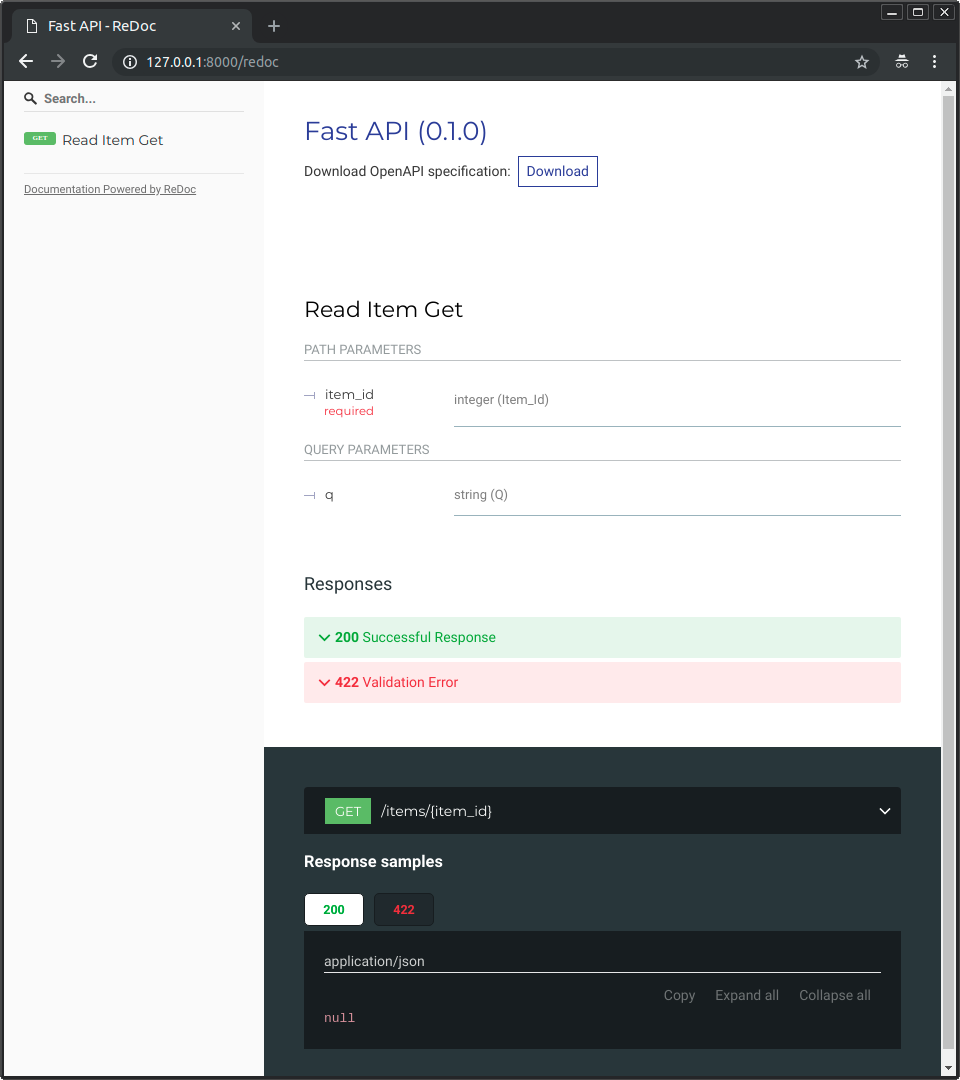
You will see the alternative automatic documentation (provided by ReDoc):
Dependencies and packages
You will probably also want to add any dependencies for your app and pin them to a specific version, probably including Uvicorn, Gunicorn, and FastAPI.
This way you can make sure your app always works as expected.
You could install packages with pip commands in your Dockerfile, using a requirements.txt, or even using Poetry.
And then you can upgrade those dependencies in a controlled way, running your tests, making sure that everything works, but without breaking your production application if some new version is not compatible.
Using Poetry
Here's a small example of one of the ways you could install your dependencies making sure you have a pinned version for each package.
Let's say you have a project managed with Poetry, so, you have your package dependencies in a file pyproject.toml. And possibly a file poetry.lock.