  ██████╗ ██████╗      ███████╗ ██████╗ ██╗      █████╗ ██████╗
  ╚════██╗██╔══██╗     ██╔════╝██╔═══██╗██║     ██╔══██╗██╔══██╗
   █████╔╝██║  ██║     ███████╗██║   ██║██║     ███████║██████╔╝
  ╚═══██╗ ██║  ██║     ╚════██║██║   ██║██║     ██╔══██║██╔══██╗
  ██████╔╝██████╔╝     ███████║╚██████╔╝███████╗██║  ██║██║  ██║
  ╚═════╝ ╚═════╝      ╚══════╝ ╚═════╝ ╚══════╝╚═╝  ╚═╝╚═╝  ╚═╝

         ███████╗██╗   ██╗███████╗████████╗███████╗███╗   ███╗
         ██╔════╝╚██╗ ██╔╝██╔════╝╚══██╔══╝██╔════╝████╗ ████║
         ███████╗ ╚████╔╝ ███████╗   ██║   █████╗  ██╔████╔██║
         ╚════██║  ╚██╔╝  ╚════██║   ██║   ██╔══╝  ██║╚██╔╝██║
         ███████║   ██║   ███████║   ██║   ███████╗██║ ╚═╝ ██║
         ╚══════╝   ╚═╝   ╚══════╝   ╚═╝   ╚══════╝╚═╝     ╚═╝
🌌 3D Solar System Simulation
Real-Time Interactive 3D Solar System — Built with OpenGL 3.3 Core Profile
A fully interactive 3D solar system simulation built from scratch using Modern OpenGL, GLFW, and GLAD — no game engine, no external math library. Features real NASA planet textures, Phong lighting, Kepler orbital mechanics, spacecraft fly mode, LOD rendering, Earth atmosphere glow, and much more.




🎬 Demo Video
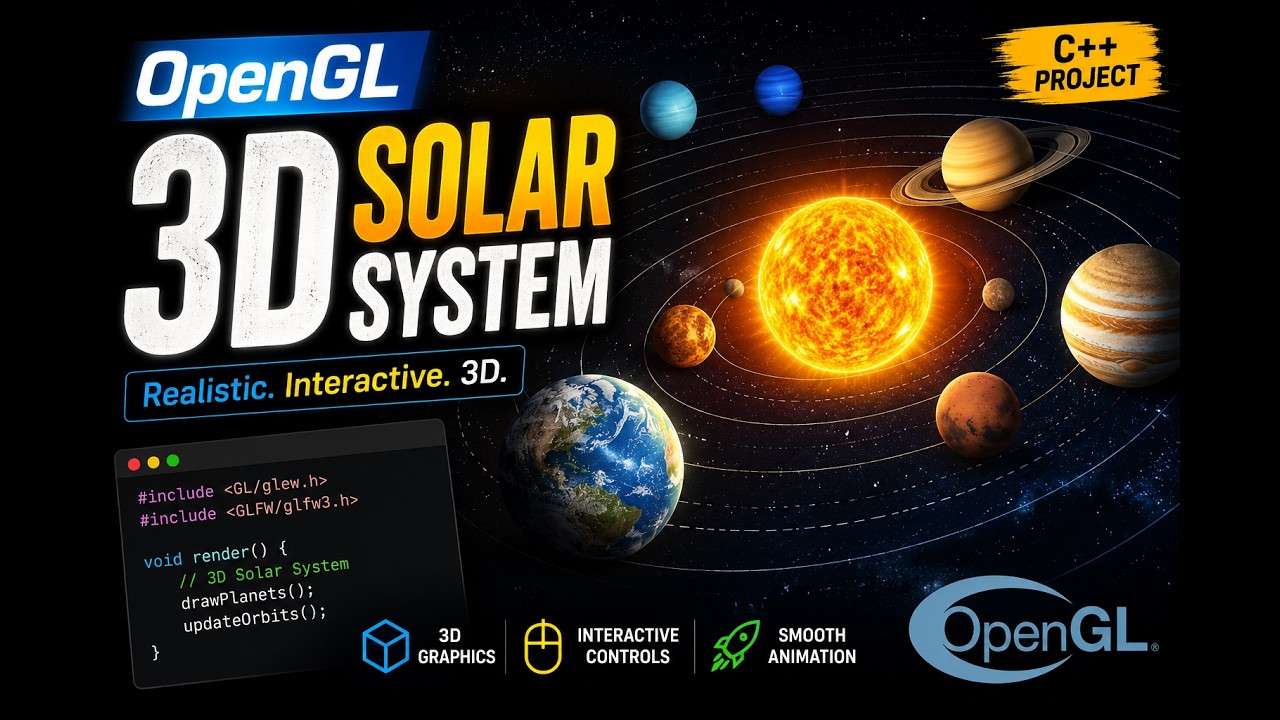
▶ Watch Full Demo on YouTube
📸 Screenshots
🌍 1. Full Solar System View
The complete solar system viewed from above. All 8 planets orbit the Sun with accurate relative speeds based on Kepler's Third Law — Mercury moves fastest, Neptune slowest. Dotted orbit rings, asteroid belt between Mars and Jupiter, and an animated comet with a glowing tail are all visible.
☀️ 2. Sun Close-Up
The Sun features a pulsing glow effect with multiple alpha-blended layers that expand and contract in real time. The surface uses a high-resolution texture with warm orange-yellow tones.
🌍 3. Earth & Moon
Following Earth (press 3) reveals the cloud layer rotating independently at 70% of Earth's self-rotation speed. The Moon orbits in real time. Phong lighting from the Sun creates a realistic day/night terminator. An atmospheric rim glow gives Earth its characteristic blue haze.
🪐 4. Saturn & Rings
Saturn's ring system features a gradient effect — inner B-ring is brighter and warmer in color, and the outer A-ring is dimmer. Rings are rendered as flat elliptical bands around the planet.
🔴 5. Jupiter & Galilean Moons
Jupiter's four Galilean moons — Io, Europa, Ganymede, and Callisto — orbit at different distances and speeds. Jupiter's texture shows its characteristic cloud bands.
🚀 6. Spacecraft Mode
Press V to enter Spacecraft Mode — freely fly through the solar system using WASD controls. Mouse drag steers, scroll wheel controls throttle, Q/E moves up and down. The title bar shows real-time position and throttle.
🌌 7. Deep Space View
Scroll out far enough and the entire solar system fits in view — planets shrink to tiny colored dots and the Sun becomes a small bright point. Stars span a 2000-unit radius field. The dynamic near/far plane ensures no clipping at any zoom level.
✨ Features
| Feature | Description |
|---|
| 🪐 8 Planets | Mercury through Neptune with real NASA textures |
| ☀️ Sun Glow | Pulsing multi-layer alpha-blended glow animation |
| 💡 Phong Lighting | Per-fragment diffuse + ambient lighting from the Sun |
| 🌍 Earth Atmosphere | Blue rim glow shader effect on Earth's edge |
| ☁️ Cloud Layer | Separate cloud sphere rotating independently on Earth |
| 🪐 Saturn Ring Gradient | Multi-ring system with inner-to-outer brightness falloff |
| 🔵 Uranus & Neptune Rings | Tilted ring for Uranus, thin ring for Neptune |
| 🌕 Moons | Earth (1), Mars — Phobos & Deimos (2), Jupiter — 4 Galilean moons |
| ☄️ Animated Comet | Elliptical orbit with sun-facing tail and orbit path |
| 🪨 Asteroid Belt | 400 randomized asteroids with brown/grey color variation |
| 📐 Kepler Orbit Speed | Planets closer to Sun orbit faster — sqrt(r₀/r) scaling |
| 🎯 Planet Follow Camera | Smooth lerp-based camera that follows any planet |
| 🚀 Spacecraft Mode | WASD + mouse free-flight through the solar system |
| 🔍 Exponential Zoom | Fast zoom when far, precise zoom when close |
| 📊 LOD Rendering | 3 sphere detail levels (64/32/16 segments) by distance |
| ⏱️ Delta Time | Frame-rate independent animation on any hardware |
| 🖥️ Planet Info Panel | Title bar shows planet name, type, moon count, day length |
| 🌟 800 Stars | Randomized star field spread across 2000 units |
🎮 Controls
| Key / Input | Action |
|---|
Mouse Drag | Rotate camera |
Scroll Wheel | Zoom in/out (exponential) |
1 – 8 | Follow Mercury → Neptune |
0 / F | Free camera (center on Sun) |
P | Pause simulation |
R | Resume simulation |
= | Increase speed |
- | Decrease speed |
V | Toggle spacecraft mode |
W A S D | Fly forward/back/left/right (spacecraft) |
Q / E | Fly up / down (spacecraft) |
Scroll | Throttle control (spacecraft) |
I | Print controls to console |
ESC | Exit |
🧮 Mathematical Concepts
Circular Orbit
$$x = r \cos(\theta), \quad z = r \sin(\theta)$$
Where r is the orbit radius and θ is incremented each frame by delta time.
Kepler's Third Law (Speed Scaling)
$$v \propto \frac{1}{\sqrt{r}}$$
float keplerSpeed(float baseSpeed, float orbitRadius) {
    return baseSpeed * sqrtf(earthOrbit / orbitRadius);
}
Phong Lighting
$$I = I_a \cdot k_a + I_d \cdot k_d \cdot \max(\hat{n} \cdot \hat{l},\ 0)$$
Smooth Camera Follow (Lerp)
$$\text{pos} = \text{lerp}(\text{pos},\ \text{target},\ \alpha)$$
float lerpSpeed = 1.0f - powf(0.92f, deltaTime * 60.0f);
smoothTargetX = lerp(smoothTargetX, targetX, lerpSpeed);
🛠️ Tech Stack
| Component | Technology |
|---|
| Language | C++ 17 |
| Graphics API | OpenGL 3.3 Core Profile |
| Window & Input | GLFW 3.4 |
| OpenGL Loader | GLAD |
| Texture Loading | stb_image.h (single header) |
| Shader Language | GLSL 330 |
| Compiler | MinGW-w64 GCC 13.3 |
| IDE | VS Code |
📁 Project Structure
3D-Solar-System/
│
├── src/
│   ├── main.cpp          # Main application, render loop, all logic
│   ├── glad.c            # OpenGL function loader
│   ├── Shader.h          # GLSL shader loader and uniform helper
│   ├── Sphere.h          # Procedural UV sphere generator (VAO/VBO/EBO)
│   └── OrbitRing.h       # GL_LINE_LOOP orbit ring renderer
│
├── shaders/
│   ├── planet.vert       # Vertex shader — MVP transform, normals
│   ├── planet.frag       # Fragment shader — Phong, atmosphere, clouds
│   ├── line.vert         # Orbit ring vertex shader
│   └── line.frag         # Orbit ring fragment shader
│
├── textures/
│   ├── sun.jpg
│   ├── mercury.jpg
│   ├── venus.jpg
│   ├── earth.jpg
│   ├── earth_clouds.jpg
│   ├── mars.jpg
│   ├── jupiter.jpg
│   ├── saturn.jpg
│   ├── saturn_ring.png
│   ├── uranus.jpg
│   └── neptune.jpg
│
├── include/
│   ├── GLFW/             # GLFW headers
│   ├── glad/             # GLAD headers
│   ├── KHR/              # Khronos platform headers
│   └── stb_image.h       # Single-header image loader
│
├── lib/
│   └── libglfw3.a        # GLFW static library (MinGW)
│
├── screenshots/
├── .vscode/
│   └── tasks.json        # VS Code build task
├── README.md
└── .gitignore
🚀 Getting Started
Prerequisites
- Windows 10/11
- MinGW-w64 — GCC 13.x, POSIX, UCRT, x86_64
- VS Code or any C++ IDE
1. Clone the Repository
git clone https://github.com/naimurhamim/OpenGL-3D-Solar-System.git
cd OpenGL-3D-Solar-System
2. Download Textures
Get free 2K planet textures from Solar System Scope and place them in the textures/ folder with the exact filenames shown in the project structure above.
3. Build
VS Code:
Ctrl + Shift + B
Manual:
g++ -o solar3d.exe src/main.cpp src/glad.c -I include -L lib -lglfw3 -lopengl32 -lgdi32 -std=c++17
4. Run
./solar3d.exe
🔧 Function Reference
| Function | Description |
|---|
main() | Init GLFW/GLAD, load textures, run render loop |
drawStars() | Renders 800 randomized stars across 2000 unit field |
drawAsteroidBelt() | Renders 400 asteroids with randomized grey/brown color |
drawComet() | Animated comet with orbit path and sun-facing tail |
drawLOD() | Selects sphere detail level based on camera distance |
keplerSpeed() | Returns orbital speed using Kepler's Third Law |
lerp() | Linear interpolation for smooth camera transitions |
lookAt() | Custom view matrix — no external math library |
perspective() | Custom projection matrix |
loadTexture() | Loads JPG/PNG textures via stb_image |
Shader class | Compiles/links GLSL shaders, sets all uniform types |
Sphere class | Generates UV sphere with positions, UVs, and normals |
OrbitRing class | Smooth orbit circle using GL_LINE_LOOP |
mouseButtonCB() | GLFW mouse button event handler |
cursorPosCB() | Camera rotation or spacecraft steering |
scrollCB() | Exponential zoom or spacecraft throttle |
keyCB() | Planet follow, speed, pause, spacecraft toggle |
🪐 Planet Data
| Planet | Orbit Radius | Size | Moons | Type | Day Length |
|---|
| Mercury | 14 | 0.5 | 0 | Rocky | 58.6 Earth-days |
| Venus | 20 | 0.9 | 0 | Rocky | 243.0 Earth-days |
| Earth | 27 | 1.0 | 1 | Rocky | 1.0 Earth-day |
| Mars | 35 | 0.7 | 2 | Rocky | 1.03 Earth-days |
| Jupiter | 50 | 2.5 | 95 | Gas Giant | 0.41 Earth-days |
| Saturn | 65 | 2.0 | 146 | Gas Giant | 0.44 Earth-days |
| Uranus | 78 | 1.5 | 28 | Ice Giant | 0.72 Earth-days |
| Neptune | 90 | 1.4 | 16 | Ice Giant | 0.67 Earth-days |
🔮 Future Improvements
📄 License
Licensed under the MIT License — see LICENSE for details.
👨💻 Author
MD Naimur Rashid
*IoT & Roboti