kolodny /
exercises
Some basic javascript coding challenges and interview questions
76/100 healthRecently updatedActive repository
JavaScriptNo license
⑂ 662 forks◯ 10 issuesUpdated 4 days ago
Loading repository data…
louiemc / repository
Basic Javascript exercises with NODEjs! Check out the README below to see the gifs/screenshots of the solutions
A transparent discovery signal based on current public GitHub metadata.
This score does not audit code, security, maintainers, documentation quality, or suitability. Verify the repository and its current documentation before adoption.
Basic Javascript exercises! Check out the README below to see the gifs/screenshots of the solutions
Expected Result Today is: Tuesday Current time is: 10 PM : 30 : 38
This is the Javscript file screenshot (easier to see the work and results). Comments are just little notes I wrote mainly for myself. This is the result of the console.log's in the code
Follow the screenshots and gifs to see what the process is!
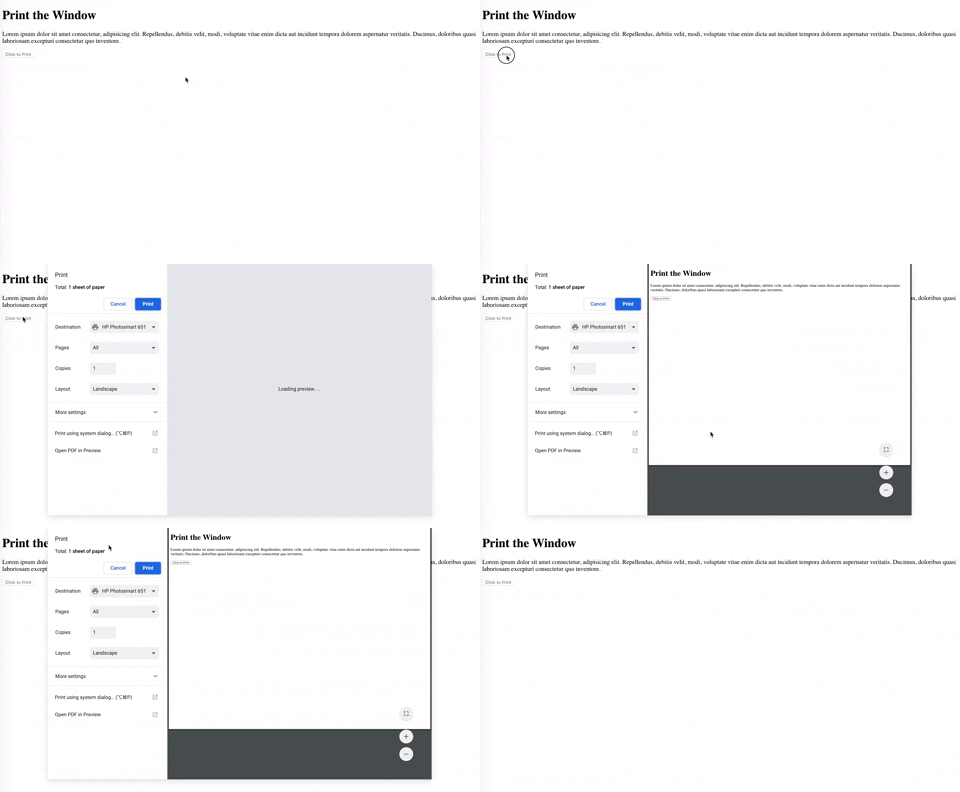
Here is the HTML page with a h1 tag and a p tag. I commented out the script tag because I wanted to see what the window would look like without JS code running.
Here the tag is uncommented from the html file. In the JS file you'll see the simple code, which opens the Print Dialog to print the current document This is what the browser looks like when the page loads (and reloads). The print dialog pops up to print the current window
But what if I don't want the print dialog to pop up when I load/reload the page? I can add a button!
Expected Result mm-dd-yyyy, mm/dd/yyyy or dd-mm-yyyy, dd/mm/yyyy
Here is the Javascript code and the process of how I came to figure this out. I definitely have a better feel of the date methods after this exercise. It's all about practice! This is the result in the console. I left the other console.log's uncommented because I wanted to see what each variable was after the if statements
If you're like me and you forgot math (face palming myself), google it. I found some sites that would calculate the area, but how could I program it to do it for me?
Then I found 'Heron's Formula.'
It's a method for calculating the area of a triangle when you know the lengths of all three sides!
Let a,b,c be the lengths of the sides of the triangle. The area is given by: Area = sqrt(p(p-a)(p-b)(p-c)) where p is half the perimeter, (a+b+c)/2
Here is the Javascript code with some comments on how I thought through this exercise:
Here is the console where I console.log-ged the results:
TBD - To Be Done
One thing to remember is: Leap Year 366 & Leap Year 365
So, I googled how to figure out if a year is a leap year:
Here is the Javascript code: using a function and returning what you want run
Here is the console where I console.log-ged the results:
Because this exercise had to do with dates I new I would have to use 'new Date' in some capacity.
I first declared the variables x and y, and then set them equal to 2014 and 2050 respectively (this was just in case I wanted to change the years in the future)
Then I used a for loop. The conditions of the for statement, which consists of 3 optional expressions enclosed in parentheses and separated by semicolons:
Now that the for loop has been started, next:
Here is the syntax for using the Date method:
What I focused on were 'year' and 'monthIndex'
But there's more!
We need to find out if January 1st falls on a Sunday between the years 2014 and 2050
So, do a strict comparison of 'z', getDay(), and 0 (Sunday) Result: line 22
If this all happens to be true, then console.log() the years that meet these requirements!
Here is the console where I console.log-ged the results:
ADD DESCRIPTION AND SCREENSHOTS
ADD DESCRIPTION AND SCREENSHOTS
Formula: c/5 = (f-32)/9
Where c = temperature in Celsius and f = temperature in Fahrenheit
Selected from shared topics, language and repository description—not editorial ratings.
kolodny /
Some basic javascript coding challenges and interview questions
76/100 healthscallops-cloud /
One-week Node.js & Express.js course: exercises & solutions for JavaScript beginner to understand various concepts to be able to build API backend server.
48/100 healthBlueGIS760404 /
Google Earth Engine Mastery: From Basics to Real-World Applications (20 Days) Target Audience: Students, researchers, GIS professionals, remote sensing enthusiasts Format: 1 lesson per day (theory + script + exercises + extension challenges) Prerequisite: Basic JavaScript knowledge (or willingness to learn on the fly)
jfarmer /
Exercises for absolute beginners with no experience coding
41/100 healthlironmiz /
Designed to help people and save the exercises I solved in javascript and track my progress and learning in algorithms, data structures, and programming math puzzles and programming basic.
37/100 healthremixtures /
My solutions to the exercises of the online course on Web server programming in Java (2021) organized by the University of Helsinki. The course teaches the principles of web applications and basic skills in developing web applications in Java.
41/100 health