LSTM-Human-Activity-Recognition GitHub Details, Stars and Alternatives | OpenRepoFinder
guillaume-chevalier / repository
LSTM-Human-Activity-Recognition
Human Activity Recognition example using TensorFlow on smartphone sensors dataset and an LSTM RNN. Classifying the type of movement amongst six activity categories - Guillaume Chevalier
A transparent discovery signal based on current public GitHub metadata.
Recent activity35% weight
100
Community adoption25% weight
72
Maintenance state20% weight
100
License clarity10% weight
100
Project information10% weight
75
This score does not audit code, security, maintainers, documentation quality, or suitability. Verify the repository and its current documentation before adoption.
README preview
LSTMs for Human Activity Recognition
Human Activity Recognition (HAR) using smartphones dataset and an LSTM RNN. Classifying the type of movement amongst six categories:
WALKING,
WALKING_UPSTAIRS,
WALKING_DOWNSTAIRS,
SITTING,
STANDING,
LAYING.
Compared to a classical approach, using a Recurrent Neural Networks (RNN) with Long Short-Term Memory cells (LSTMs) require no or almost no feature engineering. Data can be fed directly into the neural network who acts like a black box, modeling the problem correctly. Other research on the activity recognition dataset can use a big amount of feature engineering, which is rather a signal processing approach combined with classical data science techniques. The approach here is rather very simple in terms of how much was the data preprocessed.
Let's use Google's neat Deep Learning library, TensorFlow, demonstrating the usage of an LSTM, a type of Artificial Neural Network that can process sequential data / time series.
Video dataset overview
Follow this link to see a video of the 6 activities recorded in the experiment with one of the participants:
Details about the input data
I will be using an LSTM on the data to learn (as a cellphone attached on the waist) to recognise the type of activity that the user is doing. The dataset's description goes like this:
The sensor signals (accelerometer and gyroscope) were pre-processed by applying noise filters and then sampled in fixed-width sliding windows of 2.56 sec and 50% overlap (128 readings/window). The sensor acceleration signal, which has gravitational and body motion components, was separated using a Butterworth low-pass filter into body acceleration and gravity. The gravitational force is assumed to have only low frequency components, therefore a filter with 0.3 Hz cutoff frequency was used.
That said, I will use the almost raw data: only the gravity effect has been filtered out of the accelerometer as a preprocessing step for another 3D feature as an input to help learning. If you'd ever want to extract the gravity by yourself, you could fork my code on using a Butterworth Low-Pass Filter (LPF) in Python and edit it to have the right cutoff frequency of 0.3 Hz which is a good frequency for activity recognition from body sensors.
What is an RNN?
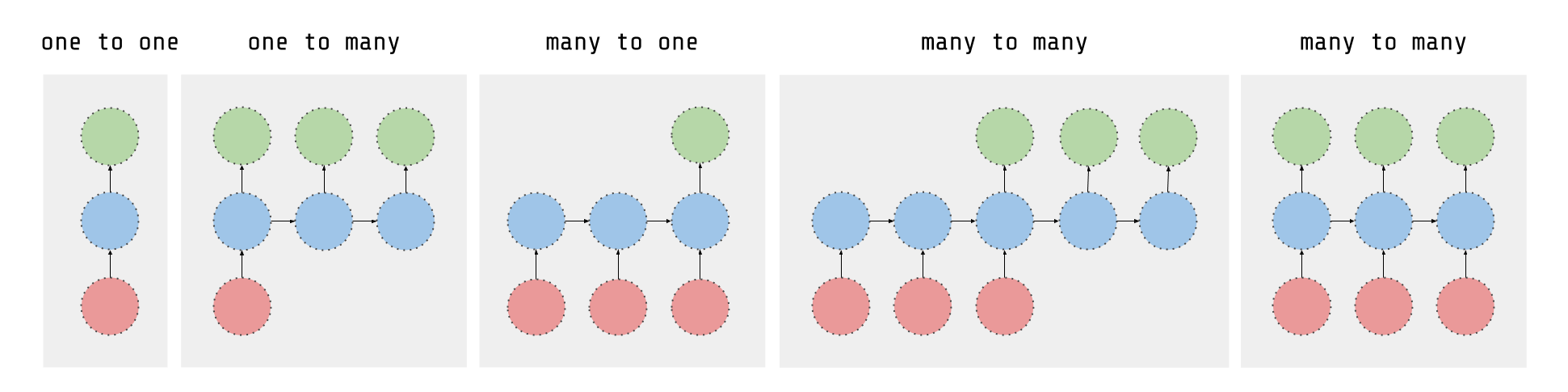
As explained in this article, an RNN takes many input vectors to process them and output other vectors. It can be roughly pictured like in the image below, imagining each rectangle has a vectorial depth and other special hidden quirks in the image below. : we accept time series of (one vector per ) to convert them to a probability vector at the output for classification. Note that a "one to one" architecture would be a standard feedforward neural network.
ALGORITHMICALLY RELATED
Similar Open-Source Projects
Selected from shared topics, language and repository description—not editorial ratings.
An LSTM is an improved RNN. It is more complex, but easier to train, avoiding what is called the vanishing gradient problem. I recommend this course for you to learn more on LSTMs.
# All Includes

import numpy as np
import matplotlib
import matplotlib.pyplot as plt
import tensorflow as tf  # Version 1.0.0 (some previous versions are used in past commits)
from sklearn import metrics

import os
# Useful Constants

# Those are separate normalised input features for the neural network
INPUT_SIGNAL_TYPES = [
    "body_acc_x_",
    "body_acc_y_",
    "body_acc_z_",
    "body_gyro_x_",
    "body_gyro_y_",
    "body_gyro_z_",
    "total_acc_x_",
    "total_acc_y_",
    "total_acc_z_"
]

# Output classes to learn how to classify
LABELS = [
    "WALKING",
    "WALKING_UPSTAIRS",
    "WALKING_DOWNSTAIRS",
    "SITTING",
    "STANDING",
    "LAYING"
]
Let's start by downloading the data:
# Note: Linux bash commands start with a "!" inside those "ipython notebook" cells

DATA_PATH = "data/"

!pwd && ls
os.chdir(DATA_PATH)
!pwd && ls

!python download_dataset.py

!pwd && ls
os.chdir("..")
!pwd && ls

DATASET_PATH = DATA_PATH + "UCI HAR Dataset/"
print("\n" + "Dataset is now located at: " + DATASET_PATH)
/home/ubuntu/pynb/LSTM-Human-Activity-Recognition
data	 LSTM_files  LSTM_OLD.ipynb  README.md
LICENSE  LSTM.ipynb  lstm.py	     screenlog.0
/home/ubuntu/pynb/LSTM-Human-Activity-Recognition/data
download_dataset.py  source.txt

Downloading...
--2017-05-24 01:49:53--  https://archive.ics.uci.edu/ml/machine-learning-databases/00240/UCI%20HAR%20Dataset.zip
Resolving archive.ics.uci.edu (archive.ics.uci.edu)... 128.195.10.249
Connecting to archive.ics.uci.edu (archive.ics.uci.edu)|128.195.10.249|:443... connected.
HTTP request sent, awaiting response... 200 OK
Length: 60999314 (58M) [application/zip]
Saving to: ‘UCI HAR Dataset.zip’

100%[======================================>] 60,999,314  1.69MB/s   in 38s

2017-05-24 01:50:31 (1.55 MB/s) - ‘UCI HAR Dataset.zip’ saved [60999314/60999314]

Downloading done.

Extracting...
Extracting successfully done to /home/ubuntu/pynb/LSTM-Human-Activity-Recognition/data/UCI HAR Dataset.
/home/ubuntu/pynb/LSTM-Human-Activity-Recognition/data
download_dataset.py  __MACOSX  source.txt  UCI HAR Dataset  UCI HAR Dataset.zip
/home/ubuntu/pynb/LSTM-Human-Activity-Recognition
data	 LSTM_files  LSTM_OLD.ipynb  README.md
LICENSE  LSTM.ipynb  lstm.py	     screenlog.0

Dataset is now located at: data/UCI HAR Dataset/
Preparing dataset:
TRAIN = "train/"
TEST = "test/"


# Load "X" (the neural network's training and testing inputs)

def load_X(X_signals_paths):
    X_signals = []

    for signal_type_path in X_signals_paths:
        file = open(signal_type_path, 'r')
        # Read dataset from disk, dealing with text files' syntax
        X_signals.append(
            [np.array(serie, dtype=np.float32) for serie in [
                row.replace('  ', ' ').strip().split(' ') for row in file
            ]]
        )
        file.close()

    return np.transpose(np.array(X_signals), (1, 2, 0))

X_train_signals_paths = [
    DATASET_PATH + TRAIN + "Inertial Signals/" + signal + "train.txt" for signal in INPUT_SIGNAL_TYPES
]
X_test_signals_paths = [
    DATASET_PATH + TEST + "Inertial Signals/" + signal + "test.txt" for signal in INPUT_SIGNAL_TYPES
]

X_train = load_X(X_train_signals_paths)
X_test = load_X(X_test_signals_paths)


# Load "y" (the neural network's training and testing outputs)

def load_y(y_path):
    file = open(y_path, 'r')
    # Read dataset from disk, dealing with text file's syntax
    y_ = np.array(
        [elem for elem in [
            row.replace('  ', ' ').strip().split(' ') for row in file
        ]],
        dtype=np.int32
    )
    file.close()

    # Substract 1 to each output class for friendly 0-based indexing
    return y_ - 1

y_train_path = DATASET_PATH + TRAIN + "y_train.txt"
y_test_path = DATASET_PATH + TEST + "y_test.txt"

y_train = load_y(y_train_path)
y_test = load_y(y_test_path)
Additionnal Parameters:
Here are some core parameter definitions for the training.
For example, the whole neural network's structure could be summarised by enumerating those parameters and the fact that two LSTM are used one on top of another (stacked) output-to-input as hidden layers through time steps.
# Input Data

training_data_count = len(X_train)  # 7352 training series (with 50% overlap between each serie)
test_data_count = len(X_test)  # 2947 testing series
n_steps = len(X_train[0])  # 128 timesteps per series
n_input = len(X_train[0][0])  # 9 input parameters per timestep


# LSTM Neural Network's internal structure

n_hidden = 32 # Hidden layer num of features
n_classes = 6 # Total classes (should go up, or should go down)


# Training

learning_rate = 0.0025
lambda_loss_amount = 0.0015
training_iters = training_data_count * 300  # Loop 300 times on the dataset
batch_size = 1500
display_iter = 30000  # To show test set accuracy during training


# Some debugging info

print("Some useful info to get an insight on dataset's shape and normalisation:")
print("(X shape, y shape, every X's mean, every X's standard deviation)")
print(X_test.shape, y_test.shape, np.mean(X_test), np.std(X_test))
print("The dataset is therefore properly normalised, as expected, but not yet one-hot encoded.")
Some useful info to get an insight on dataset's shape and normalisation:
(X shape, y shape, every X's mean, every X's standard deviation)
(2947, 128, 9) (2947, 1) 0.0991399 0.395671
The dataset is therefore properly normalised, as expected, but not yet one-hot encoded.
Utility functions for training:
def LSTM_RNN(_X, _weights, _biases):
    # Function returns a tensorflow LSTM (RNN) artificial neural network from given parameters.
    # Moreover, two LSTM cells are stacked which adds deepness to the neural network.
    # Note, some code of this notebook is inspired from an slightly different
    # RNN architecture used on another dataset, some of the credits goes to
    # "aymericdamien" under the MIT license.

    # (NOTE: This step could be greatly optimised by shaping the dataset once
    # input shape: (batch_size, n_steps, n_input)
    _X = tf.transpose(_X, [1, 0, 2])  # permute n_steps and batch_size
    # Reshape to prepare input to hidden activation
    _X = tf.reshape(_X, [-1, n_input])
    # new shape: (n_steps*batch_size, n_input)

    # ReLU activation, thanks to Yu Zhao for adding this improvement here:
    _X = tf.nn.relu(tf.matmul(_X, _weights['hidden']) + _biases['hidden'])
    # Split data because rnn cell needs a list of inputs for the RNN inner loop
    _X = tf.split(_X, n_steps, 0)
    # new shape: n_steps * (batch_size, n_hidden)

    # Define two stacked LSTM cells (two recurrent layers deep) with tensorflow
    lstm_cell_1 = tf.contrib.rnn.BasicLSTMCell(n_hidden, forget_bias=1.0, state_is_tuple=True)
    lstm_cell_2 = tf.contrib.rnn.BasicLSTMCell(n_hidden, forget_bias=1.0, state_is_tuple=True)
    lstm_cells = tf.contrib.rnn.MultiRNNCell([lstm_cell_1, lstm_cell_2], state_is_tuple=True)
    # Get LSTM cell output
    outputs, states = tf.contrib.rnn.static_rnn(lstm_cells, _X, dtype=tf.float32)

    # Get last time step's output feature for a "many-to-one" style classifier,
    # as in the image describing RNNs at the top of this page
    lstm_last_output = outputs[-1]

    # Linear activation
    return tf.matmul(lstm_last_output, _weights['out']) + _biases['out']


def extract_batch_size(_train, step, batch_size):
    # Function to fetch a "batch_size" a
This repository includes the jupyter notebooks for the initial implementation in final year research project under title "Sensor-based Human Activity Recognition". Part-2 of this project will be focused on the application of deep learning techniques for HAR , improvement in HAR classification.